Industry Project · BBC R&D · Apr – Sep 2019
Usability Study & White Paper —
BBC R&D Interactive Application
An end-to-end usability study commissioned by BBC R&D for an interactive research application. I independently recruited participants, designed and facilitated sessions, performed quantitative data analysis in R, and authored a white paper that directly informed the development team's design decisions.
Framing
Research Questions
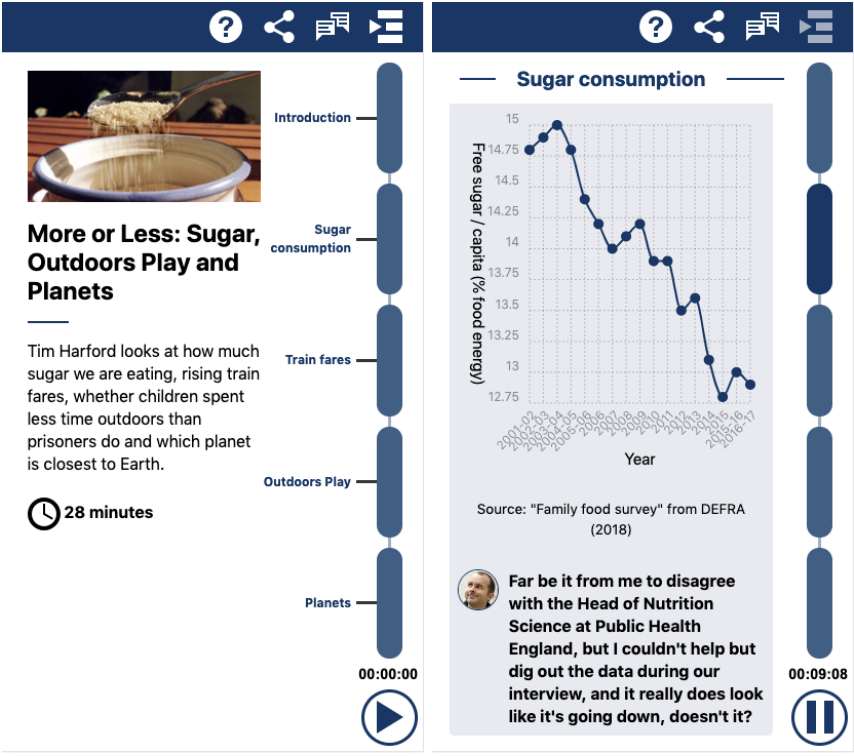
BBC R&D was prototyping an "enhanced" podcast player that layered images, transcripts, chapters and contributor links on top of standard audio. Before investing further in the concept, the team needed to understand whether and how these visual additions actually changed the listening experience in real, everyday conditions — not just in a lab. The research questions are as follows:
Study Design
Method & Recruitment
I designed this as a remote field study rather than a lab test, so participants could use the prototype in the settings where podcast listening actually happens — a deliberate trade-off of experimental control for ecological validity. We tested three environments: home, work/study, and travel (public transport or walking). Driving was scoped out early, since it wouldn't let participants safely interact with the interface.
We targeted 18–35 year-olds, a demographic the BBC was specifically trying to grow among podcast users, and recruited via university and internal research-group mailing lists. Screening criteria required participants to already listen to at least one podcast weekly and to regularly commute by public transport or on foot, so everyone could meaningfully engage with all three test environments. To keep the content itself from skewing results, I selected three real 10-minute podcast clips spanning distinct genres — factual, entertainment, and current affairs — matching the motivations prior research identified for why people listen to podcasts at all.
Artifact 01 — Study Plan
Protocol
Each session ran across five stages, moving from unmoderated first impressions through to a structured field deployment and a closing interview.
Artifact 02 — Analysis
Analysis Approach
I combined qualitative and quantitative analysis so the findings would hold up on both fronts. Interview recordings were transcribed and thematically coded, then affinity-mapped to surface patterns across participants and environments. In parallel, I analysed the participants' feature and environment rankings quantitatively in R: a Friedman test to check for overall statistical significance, followed by Wilcoxon signed-rank tests with Bonferroni correction to pinpoint exactly where the differences occurred.
Artifact 03 — Insights
Key Findings
12 of 13 recruited participants (aged 18–35, split roughly two-thirds/one-third across the age band, urban students and young professionals) completed the full study.
Outcome
Outcome & Recommendation
The clearest recommendation to come out of the study was to make the visual layer opt-in rather than always-on — letting listeners choose audio-only when their attention is elsewhere, and surface the enhanced features when they have room for them. This directly informed the department's thinking for future iterations of the prototype, and the full findings were published as a BBC R&D white paper (linked above), which I co-authored.